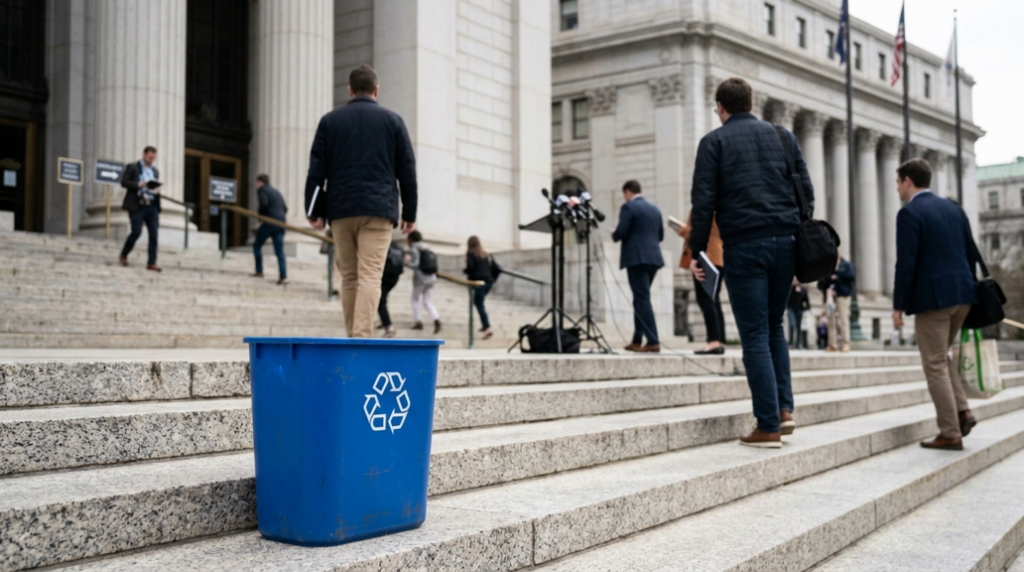
A recent judicial ruling has raised an intriguing question about the scope of First Amendment protections: could the recycling symbol itself be considered a form of free speech? This development emerged from a case examined by a judge who suggested that the widely recognized recycling emblem might fall under the umbrella of protected expressive conduct, potentially expanding the boundaries of what constitutes speech under the U.S. Constitution.
The case, reported by WhoWhatWhy, centers on whether the recycling symbol—a graphic mark used globally to indicate recyclable materials—can be classified as symbolic speech. Symbolic speech refers to actions or symbols that convey a particular message or viewpoint and are protected under the First Amendment, which safeguards freedom of speech from government restriction. Traditionally, this protection has applied to verbal and written expression, but courts have recognized that nonverbal conduct, such as flag burning or wearing armbands, can also qualify.
In this instance, the judge’s ruling did not definitively declare the recycling symbol as free speech but opened the door to that possibility. This judicial consideration reflects a nuanced understanding of how symbols function in public discourse. The recycling symbol communicates environmental values and encourages sustainable behavior, thus serving as a form of expression that transcends mere commercial or informational use. Recognizing it as protected speech could have significant implications for how symbols are regulated and used in public and private contexts.
The legal issue at the heart of this ruling involves the interpretation of the First Amendment’s protection of expressive conduct. The Supreme Court has long held that the First Amendment protects not only spoken or written words but also conduct intended to convey a particularized message that is likely to be understood by observers. The recycling symbol, as a widely recognized emblem promoting environmental consciousness, arguably fits this criterion. However, the application of free speech protections to such symbols raises complex questions about the limits of government regulation, trademark law, and commercial speech.
On one side of the debate, proponents argue that the recycling symbol’s communicative nature warrants First Amendment protection. They contend that restricting the use or display of the symbol could infringe upon individuals’ and organizations’ rights to express environmental advocacy. This perspective emphasizes the importance of symbolic expression in fostering public debate and awareness on critical issues like sustainability and conservation.
Conversely, opponents caution that extending free speech protections to universally used symbols like the recycling emblem could complicate regulatory frameworks. For instance, governments and regulatory bodies rely on standardized symbols to convey important information about waste management and recycling protocols. If such symbols are deemed protected speech, it might limit authorities’ ability to control their use, potentially leading to confusion or misuse. Additionally, trademark holders or entities with vested interests might challenge unauthorized uses, raising questions about intellectual property rights intersecting with free speech claims.
This judicial development matters significantly for journalism, media, and public debate because it touches on how symbolic communication is treated under the law. Symbols are pervasive in media and public discourse, often serving as shorthand for complex ideas or movements. If courts increasingly recognize symbols as protected speech, media organizations and publishers might gain broader latitude in using such imagery to convey messages without fear of legal repercussions. This could enhance expressive diversity but also introduce new challenges in balancing free speech with regulatory and commercial interests.
The ruling also has potential precedential value. Should higher courts affirm that symbols like the recycling emblem qualify as free speech, it could set a legal standard affecting a wide array of symbols used in political, social, and commercial contexts. This might influence future litigation involving symbolic expression, including cases about protest imagery, corporate logos, and public signage. Moreover, it could affect how government agencies regulate symbols related to public health, safety, and environmental policies.
Looking ahead, the case may proceed through appeals or further judicial scrutiny to clarify the extent of First Amendment protections for symbols. Legal scholars and advocacy groups will likely monitor developments closely, given the broader implications for free speech jurisprudence. Meanwhile, media outlets and public communicators might reassess their use of symbols in messaging strategies, considering the evolving legal landscape.
In the broader context, this ruling reflects ongoing debates about the boundaries of free speech in an increasingly visual and symbol-driven society. As the First Amendment continues to adapt to new forms of expression, courts play a crucial role in delineating what constitutes protected speech. The recycling symbol case exemplifies how legal and institutional power shapes the parameters of public debate, influencing not only what can be said but also how ideas are visually represented and disseminated.
Ultimately, the judge’s ruling invites a reconsideration of symbolic speech’s place within constitutional protections. It underscores the dynamic nature of free speech law and its responsiveness to contemporary modes of communication. For journalists, media organizations, and the public, understanding these legal contours is essential for navigating the complex interplay between expression, regulation, and public discourse in the digital age.